Unit 5, Butts Farm Courtyard, Poulton, Cirencester, GL7 5HY01793 540128
Book a consultation
Menu

Denture options · Poulton, near Cirencester

Types of Dentures

Understand your options.
Find what feels right for you.

Full or partial? Acrylic or chrome? Simon will help you make sense of the choices.

Labelled illustration comparing a complete upper and lower set with a single upper denture
One denture replaces teeth in one jaw. A set includes an upper and lower denture.

Step 1 · How many dentures do you need?

One denture
or a full set?

You may need an upper denture, a lower denture, or both. It depends on where your teeth are missing.

An upper full denture covers the roof of your mouth. Its close fit can create suction that helps it stay in place. A lower full denture has less surface to rest on, and tongue movement and the shape of your jaw can affect its stability.

Simon will assess your mouth and explain what support is available for each denture.

Step 2 · Which teeth need replacing?

Full dentures or partial dentures?

A full denture replaces all the teeth in one jaw. A partial denture replaces some of them.

A complete upper and lower acrylic denture

When all teeth in an arch are missing

Full dentures

A full denture is used when no natural teeth remain in the upper or lower jaw. It replaces those teeth and helps support your lips and cheeks, as well as helping with eating and speaking.

Upper and lower dentures have different shapes and support. Simon will assess your gums, bite and the space available before recommending a design.

Why upper and lower dentures feel different →
A chrome partial denture with spaces for remaining natural teeth

When some natural teeth remain

Partial dentures

A partial denture fills the gaps when some suitable natural teeth remain. It is made to fit around those teeth, helping with eating and appearance. A suitable design can also help limit movement of the remaining teeth.

Your remaining teeth and gums need a dental assessment. We can explain any prescription or referral needed before treatment.

About denture prescriptions →
Labelled comparison of full dentures and a partial denture with gaps for natural teeth
Full dentures replace all teeth in a jaw. Partial dentures fit around the teeth you still have.

Step 3 · Choose a suitable material

What can dentures be made from?

Comfort, appearance, strength and lifespan all matter. Simon will consider your oral health, daily routine and preferences when explaining the choices.

Illustration of traditional pink acrylic dentures
Traditional acrylic
01

Acrylic dentures

Traditional acrylic dentures have been used for many years. A pink acrylic base holds the replacement teeth. This established, often cost-effective option can be used for full or partial dentures.

Acrylic can be shaped and coloured to suit your smile, and is often relatively straightforward to adjust or repair. Simon will explain what is possible for your denture.

Explore denture pricing →
Labelled flexible partial denture showing its gum-coloured base and clasps
Flexible partial denture
02

Flexible dentures

Flexible partial dentures use a resin that bends slightly. Gum-coloured clasps can make the design less noticeable.

Some people find this helpful around sensitive areas or uneven gum contours, but it is not right for every mouth. Simon will discuss comfort, support, cleaning and any limits on repairs or alterations.

Ask whether they suit you →
Chrome partial denture showing its thin metal framework
Chrome framework
03

Chrome dentures

A carefully designed cobalt-chromium framework supports the denture teeth, usually as a partial denture.

The metal can provide strength in a thin section. The design must suit your remaining teeth, gums and bite.

A closer look at chrome →
Cobalt-chromium partial denture showing its metal framework, pink gum sections and replacement teeth
A chrome framework partial denture

A closer look at chrome

Chrome plates and frameworks

A chrome plate uses a thin metal base that rests closely against the gums and may cover part of the roof of the mouth. Its strength allows a thinner design than an all-acrylic base, which some people find less bulky for speech and comfort.

A chrome framework supports the replacement teeth and connects to suitable natural teeth with carefully planned rests and clasps. This can spread biting forces and help reduce movement during eating and speaking.

Chrome is often chosen for strength and durability, but the result depends on the design and support in your mouth. Your remaining teeth, gums and bite must be assessed. Simon will also explain where metal may show and whether future changes are likely.

Behind the finished denture

How are dentures made?

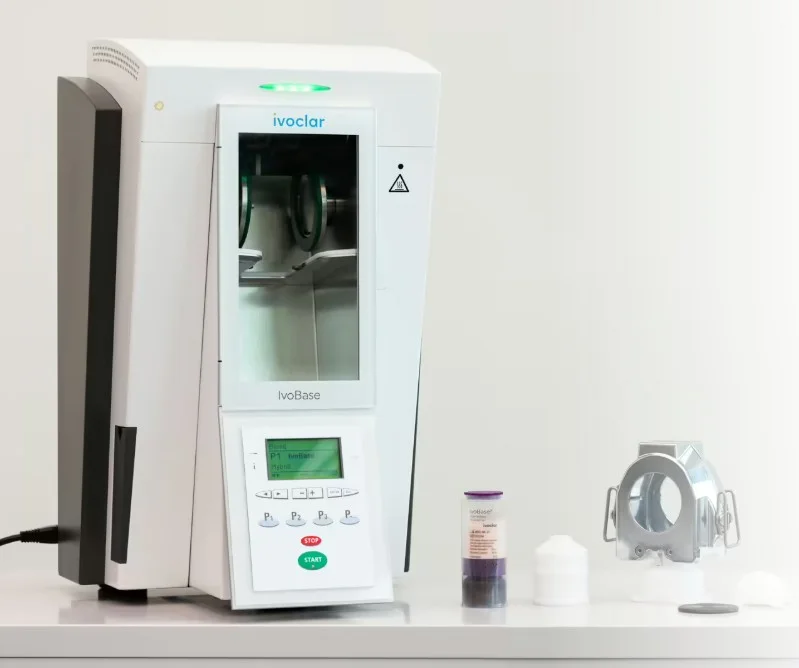
Ivoclar IvoBase denture injection-moulding machine

Injection-moulded dentures

Injection moulding is a way of making the denture base. It can be used to make an accurately shaped, consistent acrylic base, supporting the fit, finish and strength of the completed denture.

Available at Cotswold Denture Clinic: our own laboratory uses the Ivoclar IvoBase injection-moulding system. It controls how the acrylic material is injected and hardened. Your individual fit still depends on careful clinical measurements and fitting.

More about our laboratory →
Illustration of denture bases arranged for digital manufacturing
Illustration of digital denture production

Digital manufacturing

What about 3D-printed dentures?

A digital scan, or an impression converted into a digital model, can be used to design dentures on a computer. Suitable resins can then be used to 3D-print the planned shapes with precision.

Keeping the digital design can make it easier to reproduce a previous design when a replacement is needed. Your mouth still needs checking, because its shape may have changed. The material, finish and fit remain important.

Ask Simon which methods are available and suitable for your treatment.

Discuss your options →

You don’t need to decide alone

Let’s work out
what suits your mouth.

At your consultation, Simon will ask about your current dentures, what you find difficult and what you would like to change. He’ll explain suitable options and provide a personalised quotation before you decide.

If you have natural teeth or implants, a dentist’s involvement may be needed for assessment and a prescription.

Build a denture estimate →

Already have dentures that feel fine?

You can still book a Denture MOT to check their fit, condition and comfort. If something has changed, Simon can explain whether an adjustment, repair or replacement would help.

Book a Denture MOT →Help with a broken denture →Browse Denture Q&A →
Further reading: NHS guide to dentures ↗